The Producer Trap: When Being Good at Sales Keeps You From Building a Great Business
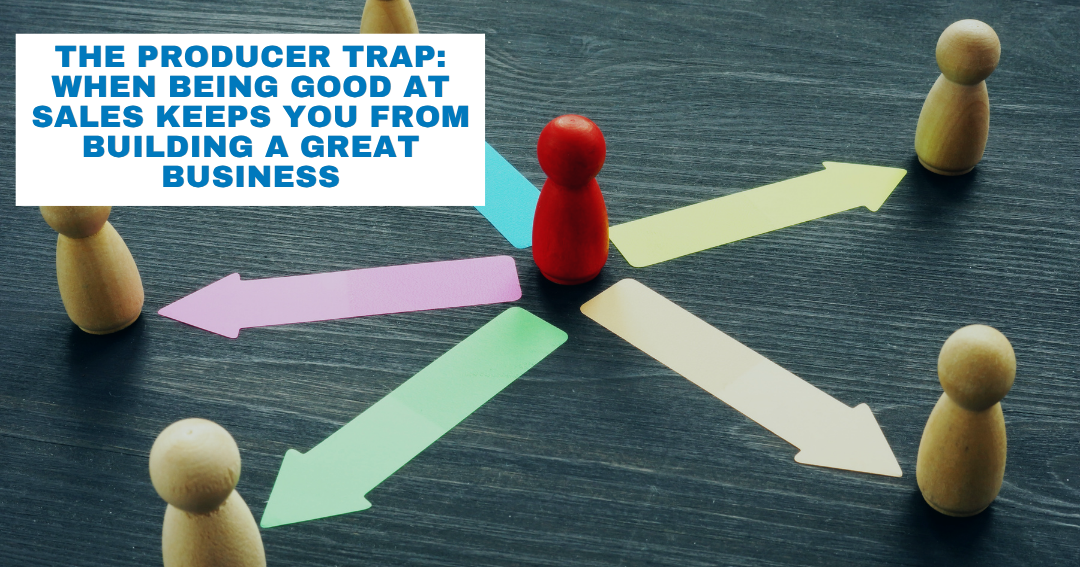
Some of the habits that make you an exceptional producer can become liabilities as the business grows. A talented loan officer can rescue a difficult file. A strong real estate agent can calm an unhappy client, negotiate through a problem, remember every detail of every transaction, answer the phone at all hours, and personally make sure nothing falls through the cracks. Those instincts can build a very successful career. They can also leave you with a business that cannot function without you.
That is the producer trap: your talent keeps solving problems that the business itself should eventually learn to solve. The better you become at personally carrying the business, the longer you can postpone building a business that does not require you to carry everything. Eventually, that becomes costly — in time, money, and the ability to grow.
Success can hide a systems problem
When production is growing, it is easy to assume the business is growing with it. Those are not necessarily the same thing. You can close more loans or sell more homes while becoming more overwhelmed. You can hire people while remaining the person everyone comes to for every decision. You can increase revenue while allowing expenses to grow faster than they should.
From the outside, that looks like success. From the inside, it can feel like a job that has become too large for one person. At that point, production is no longer the only measure of progress. The business itself has to become stronger.
The skills that got you here may not get you there
Early in a career, personal effort can solve an enormous number of problems. Make more calls. Meet more people. Serve clients better. Work harder. Learn to sell. Improve your conversion. Build your reputation. Those disciplines matter. They never stop mattering.
But once production reaches a certain level, growth introduces a different set of problems. Now it's who to hire next, what that person should actually own, which of your daily tasks belong to someone else, whether a new lead source is even profitable, whether your team knows what good performance looks like, and what happens when you're not available. Those are ownership questions, and they require a different kind of discipline than selling. Being a great salesperson does not automatically prepare you to answer them.
If every decision still comes through you, you do not have leverage
Hiring alone does not create scale. Sometimes a producer hires an assistant or builds a team but never truly gives anything away. The team performs tasks, but the producer remains the central nervous system of the entire operation. Every unusual situation comes back to them. Every important client needs them. Every problem requires their approval. The producer becomes the bottleneck without realizing it.
That isn't really delegation — it's just spreading out the tasks while keeping every ounce of the responsibility yourself. Real leverage requires clearer roles, stronger processes, measurable standards, and enough trust to allow other people to perform without being constantly rescued. Doing it yourself is often faster — until doing everything yourself becomes the very thing preventing the business from getting bigger.
Revenue can hide bad decisions, too
The producer trap is not only about time. It is also about money. A high-producing business can tolerate inefficiency for a surprisingly long time. Excess payroll, unnecessary subscriptions, weak marketing investments, poor compensation structures, and expensive habits can disappear inside strong revenue. Until the market changes. Or production dips. Or the producer finally looks closely at the P&L and realizes that making more money has not translated into keeping enough of it.
This is why The CORE focuses not only on production, but also on financial discipline. A producer thinks about the next closing. An owner has to think about what the business earns, what it spends, what it keeps, and what those numbers are building over time. High production matters. So does what the business is becoming behind that production.
Your business should eventually give something back to you
There is nothing wrong with working hard. The CORE was not built around avoiding work. But the purpose of all that effort cannot be to create a machine that requires more of you every year just to keep running.
A stronger business should eventually create leverage: more capable people, better systems, clearer numbers, more predictable production, and more intentional use of your time. And ultimately, more of the income, freedom, and wealth that made building the business worthwhile in the first place. That transition does not happen automatically because you hit a certain production number. You have to build it.
It may be time to stop coaching only the salesperson
This is where business coaching should change as the producer changes. At The CORE, mortgage coaching and real estate coaching are designed to meet professionals at different stages of growth. The work evolves from strengthening production and daily execution to building teams, understanding the P&L, making smarter hiring and expense decisions, creating leverage, and developing a business that can scale. For established producers ready to work on those decisions at a deeper level, The CORE Summit brings mortgage and real estate professionals together to focus on systems, leadership, profitability, and scale.
For a high producer, the next stage of coaching is not simply about squeezing out more production. It is about building something bigger without making your own life smaller.
If you are producing at a high level but still feel like your business depends on you for everything, book a Strategy Call with The CORE.
Not ready for full coaching? The CORE Locker Room gives loan officers and real estate agents access to live coaching, proven tools, and a community of professionals serious about building stronger businesses.
The next breakthrough may have less to do with another sales tactic and more to do with becoming the owner of the business your talent has already created.
share this
Related Articles
Related Articles